BeeBlog
Mite management
by Ruhl Bee on 08/30/13
If you have not treated your hive for varroa mites yet, you can still do it. Eliminating mites at this time of year helps the colony go into winter in the best health. Numerous treatments are available, ranging from completely natural methods to hard chemical treatments. Powdered sugar dusting helps remove phoretic mites but does nothing to brood mites. Apiguard works well and is considered on the "softer" side of the range of mite treatments. Its active ingredient is thymol, which is a component in oil of thyme. Acid based products such as formic acid are very effective but are easily incorrectly applied. Always ventilated the hive well when using this treatment. Systemic miticides such as Apivar are effective, but certainly not for the natural/organic beekeeper. Regardless of the treatment method you prefer, the most important thing is to do it right away.
Herbal bee heaven
by Ruhl Bee on 08/10/13
Yes, bees love the herbal plants, and their general drought tolerance makes them great for summer nectar. Last posting, we talked about borage and lavender. Our bees are still working the borage in the bee garden, and while some of the lavender is finished, other varieties are still yielding nectar.
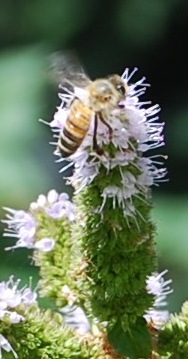
Mint is another fabulous bee plant. It grows well in the Willamette Valley, and, with a bit of watering, provides good forage well into mid-summer. Our bees are still working the mint hard (upper right), but the forage is starting to decline now.
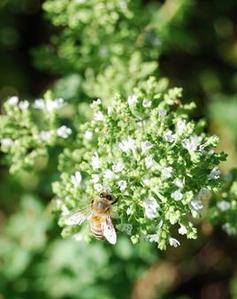
Another excellent plant for the bee garden is oregano. This time of year, our oregano plants are humming with bees. This herb comes on just a little later than mint in our garden, so it provides forage continuity (lower right).
Mediterranean herbs for late nectar flow
by Ruhl Bee on 07/31/13
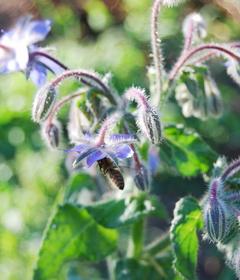
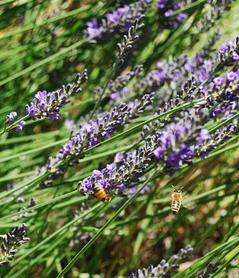
Keeping a sustained nectar flow after the blackberry flow is not always easy in the Willamette Valley. Another great mid-season forage plant for honeybees is the beautiful blue plant, borage (third right). Plant as much in your bee yard as you can.This Mediterranean herb, along with many others, blossoms comfortably after the blackberry nectar flow, and is a favorite in our bee yards. It is a great addition to any bee garden. And while we are talking about blue blossoms of Mediterranean plants that the bees love, we could hardly skip lavender (fourth right). This Mediterranean herb is a big hit with bees. In fact, in our bee yards, the bumblebees seem to dominate the lavender. You can get varieties that bloom at different times to stretch out the nectar flow. Ask your local nursery about this for your region.
After the Blackberry flow
by Ruhl Bee on 07/21/13
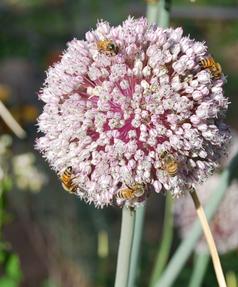
Allium is another plant in our bee garden the bees love to frequent. Like the leek, it is part of the onion genus, and in the third week of July in the Willamette Valley, the bees are still working foraging it. The Allium comes in a wide range of colors and shapes. In our bee garden they look like the image on the right.
What happens after the Blackberry flow?
by Ruhl Bee on 07/13/13
Now the Blackberry nectar flow is pretty much behind us, what is left for the bees to forage? We will explore this over the next few weeks. Of course, this is just a feeble excuse to take pictures of bees on flowers, but we just can't help it. Honeybees love leeks. Part of the onion and garlic family,they make a fabulous source of forage if you let them go to seed. In the Willamette Valley, they overlap with the blackberry flow but are still going strong in July when the blackberry flow is in fast decline. As you can see in the image (right), they are a beautiful addition to the garden.
Water
by Ruhl Bee on 06/30/13
Remember to keep a good source of water near your hives. The less time and energy the bees expend on gathering water, the more time they can spend on gathering nectar. Make sure the water source has a landing are for the bees. They often drown if they land directly on water. A good option is the bird bath. The bowl shape allows the bees to walk down to the water.
Nectar Flow
by Ruhl Bee on 06/24/13
Willamette Valley nectar flow is still strong. We could do with a bit more sun to get the bees moving, but this moisture helps the nectar production. It is best to stay out of your hives during the main flow, so the bees can get on with their business uninterrupted. If an inspection is unavoidable, don't linger, and try to minimize the disruption. East of the Cascades, honey production is looking encouraging.
Foundationless vs. topbar beekeeping
by Ruhl Bee on 06/05/13
Top-bar beekeepers like the idea of letting the bees build comb cells to the size and location they want, instead of being forced to conform to a starting foundation. If you want to step into top-bar beekeeping, but are hesitating, try foundationless beekeeping. If offers a good bridge between Langstroth and top-bar beekeeping. Like a top-bar hive, the foundationless hive has no foundation, but has a starter strip of wax on the underside of the top bar to guide the bees comb building activity. However, unlike a top-bar hive, it does use a frame. As the bees draw out the comb, they inevitably attach it to parts of the frame, providing great support. The frame also "isolates" the comb from the box, so inspections are not fraught with the tedium and damage-risk of having to cut the top-barcomb away from the box.
Feed Your Package Bees
by Ruhl Bee on 05/27/13
With this long spell of rain here in the Willamette Valley, bees have a hard time acquiring enough forage. You can assess their food storage by tilting the back of the hive from the cup handle. If it feels heavy, they are probably OK. If light, you should supplement their food. Package bees are especially vulnerable since they have had insufficient time to build up stores. The package bees in our field lab are devouring all the food we give them.
A few dead bees
by Ruhl Bee on 05/24/13In the rainy and cool weather of this week, it is not unusual to see a few dead bees in front of your hive or on top. The bees spend this cooler weather catching up on housekeeping. which includes removal of dead bees. Also, sometimes bees venturing out between rain showers get stuck in rain or small puddle of water on top of your hive. Once their wings are wet, they have a hard time maneuvering.